This work was supported by the National Science Foundation Division of
Undergraduate Education under Grant No. 1819235.
The QLAB project focused on understanding how institutions can strengthen their support for students’ quantitative skills development and supporting faculty and staff who are interested in making changes in their local context. Through a series of structured conversations with campus dialogue leaders from eight different small, selective liberal arts colleges, we identified that most institutional efforts to support incoming students’ quantitative skills development fall into one of four domains: bridge programs, assessing readiness, curricular on-ramps, and supplemental support.
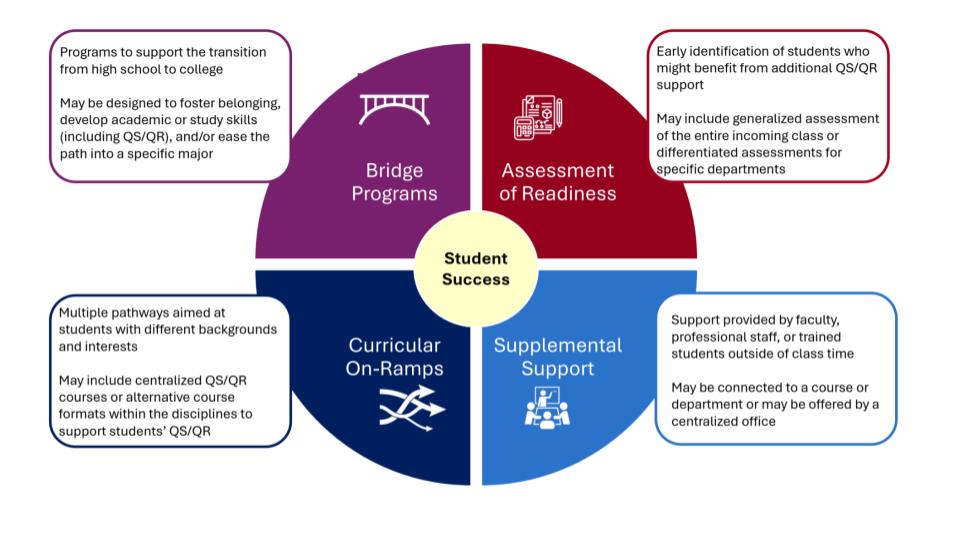
However, often lack of institutional coordination results in either gaps or duplicative efforts. Engaging in conversations with stakeholders and helping grassroots leaders understand how to develop a theory of change are important in efforts aimed at enhancing quantitative skills support within a college to ensure student success.
If you are at a liberal arts college and your institution is grappling with these issues, we can offer workshops or other professional development activities based on what was learned through this project.
Key QLAB publications, presentations
2025
- Workshop for institutions of the Associated Colleges of the Midwest: Institutional Approaches to Quantitative Skills Support
- L. J. Muller, M. Eblen-Zayas, “A Framework for Strengthening The Quantitative Skills/Reasoning Support Ecosystem at Small Liberal Arts Colleges”, Numeracy 18, Iss. 1: Article 3. doi:10.5038/1936-4660.18.1.1465
2024
- Workshop: Using an ecosystem framework to support practitioners in changing the institutional quantitative skills support landscape – AAC&U Transforming STEM Education Conference, Washington DC
- Contributed poster, L.J. Muller & M. Eblen-Zayas, “Quantitative skill support ecosystem model for aligning institutional change efforts”, 2024 IUSE Summit, Washington DC
2023
- M. Eblen-Zayas, L. J. Muller, J. S. Russell, “Possibilities and Pitfalls of Practitioners in Trying to Apply Change Theory as Viewed Through the Lens of Reinholz, White, and Andrews ‘Change theory in STEM higher education: a systematic review’”, International Journal of STEM Education, 10(1), 53. doi:10.1186/s40594-023-00446-3
- Discussants as part of ASCN Change Theories in Practice Discussion Series
- ASCN blog post: “What what we wish we had known about theories of change and change theories at the beginning”
- Contributed talk: M. Eblen-Zayas, L. Muller, “A Case Study of How STEM Education Practitioners Think about Change Theory, Change Strategies, and Making Relevant Project Choices”, 2023 Transforming Institutions Conference, Minneapolis, MN
- Contributed poster: L. Muller, M. Eblen-Zayas, “Fostering inter-institutional learning to understand quantitative skills support ecosystems,” 2023 Transforming Institutions Conference, Minneapolis, MN
2022
- Facilitated discussion: Laura Muller, Melissa Eblen-Zayas, Lin Winton, Jonathan Leamon, “Models for engaging faculty and staff on cross-institutional projects”, AAC&U Transforming STEM Education Conference, Alexandria, VA
2021
- Facilitated discussion: Melissa Eblen-Zayas, Laura Muller, J. Leamon, S. Richard, E. Altermatt, E. Iverson, K. O’Connell, “How faculty support student quantitative skills development in online environments,” National Numeracy Network Conference (online)
2020
- Innovation/Ideation Session: Melissa Eblen-Zayas, Laura Muller, “Supporting student quantitative skills in online environments,” AAC&U Transforming STEM Conference (online)
- M. Eblen-Zayas, E. Altermatt, L. Muller, J. Leamon, S. Richard, “Supporting student quantitative skills across introductory STEM courses: faculty approaches and perceived needs”, 2020 Physics Education Research Conference Proceedings, edited by S. Wolf, M. B. Bennett, and B. W. Frank, 137, doi: 10.1119/perc.2020.pr.Eblen-Zayas
Origin of QLAB
QLAB grew out of activities of the Liberal Arts COLlaborative (LACOL) for Digital Innovation. The LACOL consortium had a shifting membership during its lifetime, but included about 10 small, selective liberal arts colleges, and the focus of the consortium was to explore the affordances and challenges of technology-enhanced teaching and learning in the context of these institutions.
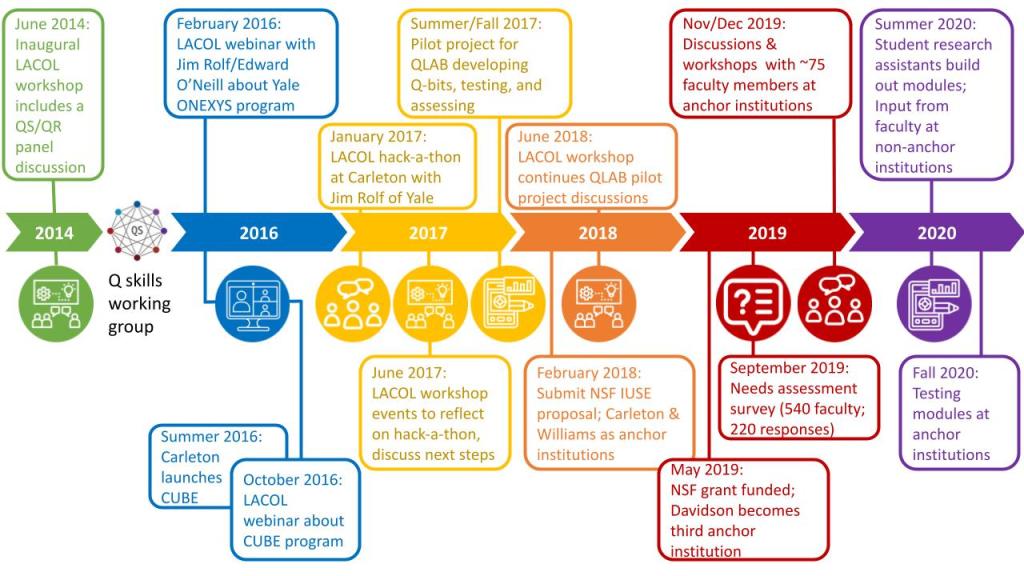
The role that technology-enhanced teaching might play in supporting student quantitative skills development was an area of interest for LACOL beginning in 2014. Faculty and staff at LACOL institutions identified a shared challenge – the range of quantitative skills that our entering students bring – and benefited from hearing about each other’s approaches. These conversations led to the development of the QLAB project, which started as an effort to build online modules to provide students with just-in-time review of quantitative skills taught in high school math courses and demonstrating the relevance of those skills in a variety of science & social science contexts. These efforts were informed by online quantitative skills-focused bridge programs at Yale University (ONEXYS) and Carleton College (CUBE).
QLAB online module development
- The 2017 pilot project involved faculty and staff at six different LACOL institutions developing and testing prototype modules to support student review of quantitative skills. Working towards a deliverable item made the collaboration more tangible.
- In 2019, the project received a $290,940 NSF IUSE grant.
- A consortium-wide needs assessment survey in September 2019 to faculty teaching intro STEM and social science courses garnered responses from 220 faculty members and was critical for prioritizing the topics selected for initial module development. The results of the needs assessment were published in the 2020 Physics Education Research Conference Proceedings.
- The Fall 2019 round-robin discussions and workshops at Carleton College, Davidson College, and Williams College involved ~75 faculty members.
- Student research assistants for the project supplemented faculty perspectives with student perspectives during the design and development of the first three modules.
- Feedback from six faculty members at Carleton, Davidson, and Williams who used the modules in Fall 2020 was extremely positive.
- About 30 faculty from non-anchor institutions have participated in QLAB activities in 2020 and 2021.
Moving from online modules to institutional approaches
In our original proposal, the focus of the initial phase of grant activities was on individual faculty choices and engagement in module development and faculty learning communities around supporting student Q skills. However, due to the disruption of the pandemic and a subsequent sense of burnout among faculty members, we shifted our focus from exploring factors that impact individual faculty choices about approaches to supporting student quantitative skills development in their courses to considering factors that impact departmental or institutional choices about approaches to supporting student Q skills development more broadly. This did not require the same level of commitment from individual faculty members during a period of severe disruption.
In 2022, we invited the Chief Academic Officers at LACOL institutions to identify a faculty or staff member to represent their campus in structured conversations over the course of six months designed to help us understand how institutions were trying to support student quantitative skills development. Working with these campus dialog leaders allowed us to compare and contrast approaches to department level and institutional level approaches to supporting students. These conversations, and a follow-up workshop in the fall of 2023, were the foundation for developing the framework for strengthening the quantitative skills support ecosystem that was published in Numeracy.
Key personnel
The original NSF proposal was developed by Melissa Eblen-Zayas (Carleton College), Jonathan Leamon (Williams College), Laura Muller (Williams College, now Jackson Laboratory), and Janet Russell (Carleton College). Sundi Richards (Davidson College) also served as a co-PI for a period of the grant. Please reach out directly to Melissa or Laura, or fill out this form to request additional information about the project.
 melissaeblenzayas.com