I have been a physics faculty member at Carleton College since September 2005, teaching introductory and intermediate courses throughout the physics sequence and upper-level courses such as Solid State Physics, Electronics, and Contemporary Experimental Physics.
I work to incorporate research-based effective practices in my course design and teaching practices in order to make my courses more accessible and welcoming for all students. First and foremost, I prioritize getting to know my students and appreciating what they bring to the class learning community. I also try to:
- Be transparent in my teaching, including using the Transparency in Learning and Teaching (TILT) framework when appropriate.
- Improve the accessibility of my course for all learners by employing elements of the Universal Design for Learning (UDL) framework.
- Be mindful of the error climate in my classroom.
- Design and monitor small group work in my courses to foster effective group functioning.
- Include metacognition and reflection activities to encourage students to think more deeply about how and what they learn.
Both through my own teaching and through my efforts to support junior faculty members in their development as teachers, I have come to understand the ways that pedagogical choices may be constrained by the extent to which an instructor embodies authority and expertise. Building on my own teaching experiences as a woman in a traditionally male-dominated field, I wrote a chapter for Picture a Professor: Interrupting Biases about Faculty and Increasing Student Learning edited by Jessamyn Neuhaus.
Independent projects in the advanced lab
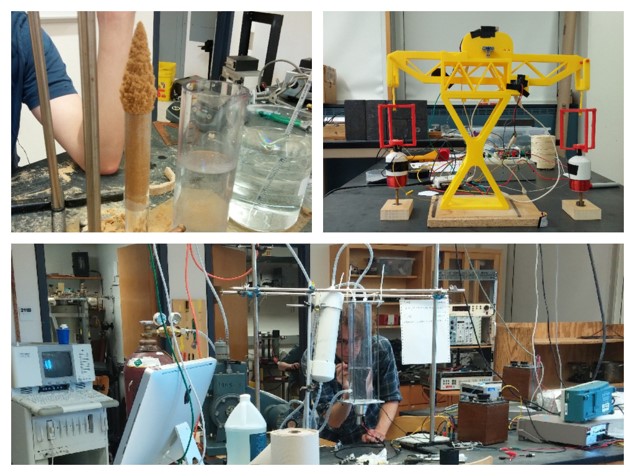
I am interested in questions related to curricular design and instructional approaches in laboratory classes. I redesigned the advanced lab course to provide students a significant independent project experience. The structure for these projects is described in the chapter that I wrote for Experimental Physics: Principles and Practice for the Laboratory edited by Walter F. Smith of Haverford College. Publications and presentations related to my redesign of curricular labs include:
- Invited talk: “An evolving approach to assessment in upper-level labs,” 2019 AAPT Summer Meeting, Provo, UT
- Peer-reviewed conference proceeding: M. Eblen-Zayas and R. C. Terrien, “Lessons learned from five years of student self-directed experimental projects in the advanced lab,” 2018 Conference on Laboratory Instruction Beyond the First Year of College Proceedings, edited by M. Eblen-Zayas, E. Behringer, M. Dark McNeese, and E. Geneston, doi:10.1119/bfy.2018.pr.003
- Invited talk: “Experimental design in curricular labs,” 2018 Conference on Laboratory Instruction Beyond the First Year of College (BFY III Conference), Baltimore, MD
- Peer-reviewed conference proceeding: M. Eblen-Zayas, “The impact of metacognitive activities on student attitudes towards experimental physics,” 2016 PERC Proceedings, edited by D. L. Jones, L. Ding, and A. Traxler, 104, doi:10.1119/perc.2016.pr.021
- Peer-reviewed conference proceeding: M. Eblen-Zayas, “Comparing electronic and traditional lab notebooks in the advanced lab,” 2015 Conference on Laboratory Instruction Beyond the First Year of College Proceedings, edited by M. Eblen-Zayas, E. Behringer, and J. Kozminski, doi:10.1119/bfy.2015.pr.007
Academic Civic Engagement Projects
Currently, my teaching load is entirely in the physics department, but earlier in my time at Carleton, I designed and taught a course in environmental studies titled Materials Science, Energy, and the Environment, which focused on materials life cycles and the trade-offs that are involved when choosing materials for different energy-related applications, from green buildings to photovoltaic panels. In that course, I asked students to engage in Academic Civic Engagement (ACE) projects that had students working with community partners on projects that demonstrated how course topics were relevant to projects in the local community. The real-world problem solving was transformative for my students. At the same time, developing and sustaining relationships with community partners was challenging, and students often wanted to find ways to continue their involvement with a project after a course had ended.
Martha Larson, Director of Campus Sustainability, Adrienne Falcon, Director of the Center for Civic and Community Engagement, and I developed a project stream model for ACE projects with a single sustainability issue serving as the source of the project stream, which could be supported in a number of ways: ACE projects embedded in a traditional 6-credit course, specialized 2-credit courses with ACE projects as the central focus, student independent study projects, work-study hours, and internships/externships. The curricular and co-curricular activities and assignments served as feeders for the project stream, providing ways for students with academic knowledge, creativity, and enthusiasm, to connect with the project for brief periods, while sustaining projects over the long term.
For this work, I was named Carleton’s 2015 Minnesota Campus Compact Presidents’ Civic Engagement Steward. Martha Larson and I also presented our work at the 2015 American Association of Sustainability in Higher Education Conference, sharing three project streams as case studies: developing a campus sustainability project guide, assisting the Northfield Environmental Quality Commission with a community curbside composting pilot program, and supporting Northfield in its efforts to meet GreenStep Cities best practices.
 melissaeblenzayas.com